Caution, technology
If you start researching climate-neutral ships, you realize that there have been an increasing number of projects in the last ten years that aim to free the maritime world from fossil fuels. Wind is celebrating a renaissance. Multi-masted schooners or brigantines, modern sailing ships equipped with the latest technology, are sending out a signal that freight can also be transported without emissions. Old ships and new ships based on old models can be found on the seas as luxurious sailing cruise ships. But the wind remains a somewhat unreliable source of propulsion.
So how can we arrive at our destination on the other side of the ocean without a combustion engine, in a climate-neutral way and reliably according to schedule? Fuel cells are increasingly crystallizing as a solution. They transform hydrogen into electricity. This then drives electric motors and provides the energy for hotel operations. However, it is clear that there is still no experience of testing this over the long term. Much is still under development.
Save Planet Liners has confidence in the technology and is convinced that major advances will be made in the efficiency of fuel cells over the next few years.
Hydrogen initially seems to be the best solution as an energy source. Hydrogen can be transformed directly in the fuel cell, produces zero emissions and can be produced in a green way. However, liquid hydrogen requires 4.8 times the volume of diesel for the same amount of energy and only liquefies at -253°C. The large volume and the high energy consumption for cooling argue against its commercial use in long-distance passenger shipping.
After analyzing several alternative energy sources, the decision was made to use green methanol. Methanol is liquid and can be stored in tanks like gasoline or diesel. It only needs 2.4 times the volume of diesel to store the same amount of energy. It is also biodegradable. Disadvantage: Methanol is toxic and very flammable.
A plant for the production of green methanol is currently being built in Stade, which will produce 200,000 tons of green methanol per year. Production facilities are being built throughout Europe. Plants for the production of green methanol are also currently being built on the east coast of the USA.
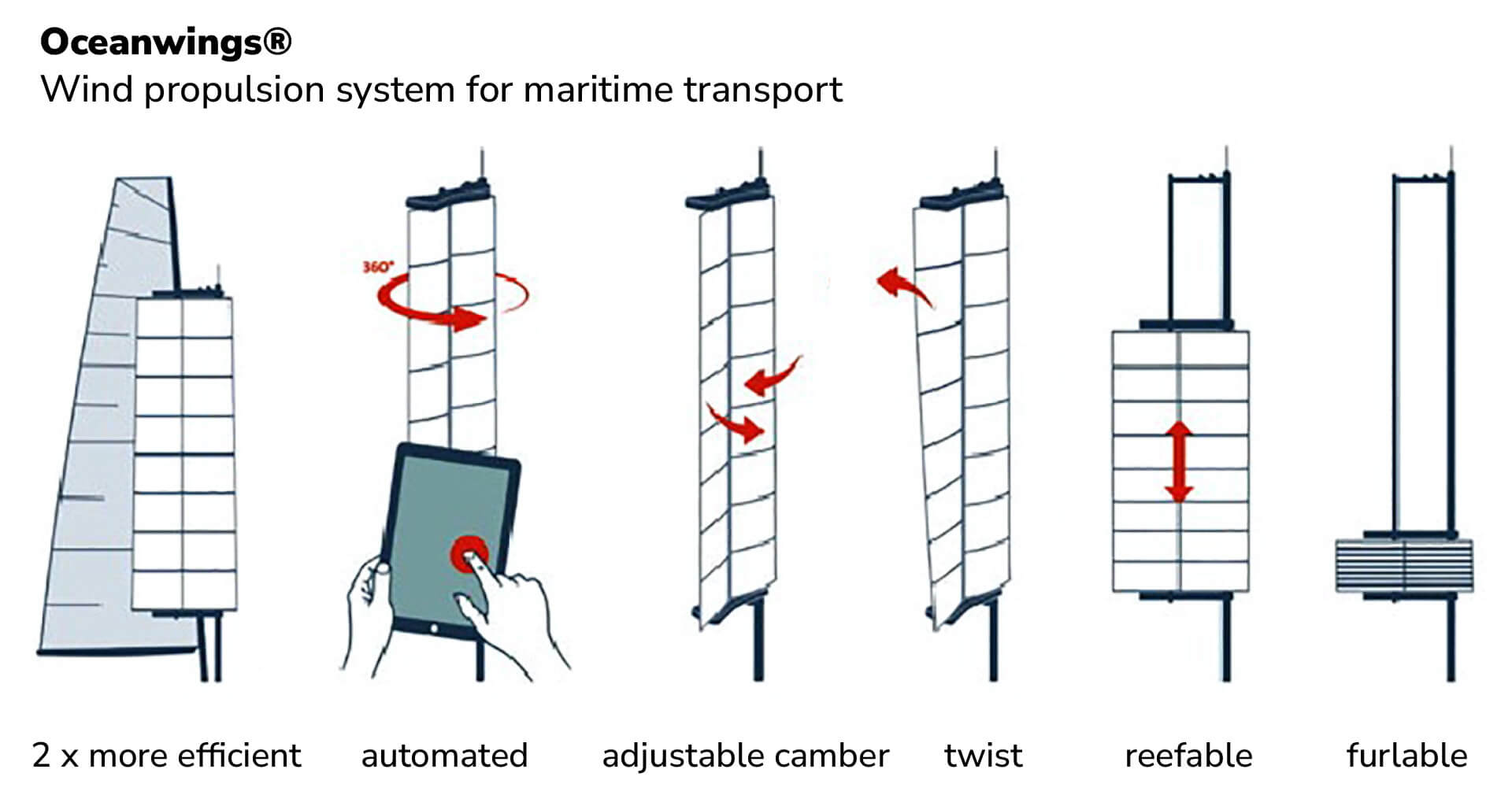
But Save Planet Liners doesn't want to do without the wind either. We have opted for Oceanwings from the French company Ayro. The USA17 boat won the America's Cup with Oceanwings in 2010. The boat and wings were designed by naval architects VPLP and later developed further and industrialized as a fully automated product. Oceanwings are vertical wings that can be reefed when the wind is too strong. Compared to traditional sails of the same surface area, they generate around twice the power. They also allow a much higher course upwind. At a cruising speed of 12 knt, taking into account the annual weather on the North Atlantic, the energy saving for our ship on a voyage from Hamburg to New York is 40% thanks to Oceanwings.